Fela Kuti | ||
| Allmusic Biography : Its almost impossible to overstate the impact and importance of Fela Anikulapo (Ransome) Kuti (or just Fela as hes more commonly known) to the global musical village: producer, arranger, musician, political radical, outlaw. He was all that, as well as showman par excellence, inventor of Afro-beat, an unredeemable sexist, and a moody megalomaniac. His death on August 3, 1997 of complications from AIDS deeply affected musicians and fans internationally, as a musical and sociopolitical voice on a par with Bob Marley was silenced. A press release from the United Democratic Front of Nigeria on the occasion of Felas death noted: "Those who knew you well were insistent that you could never compromise with the evil you had fought all your life. Even though made weak by time and fate, you remained strong in will and never abandoned your goal of a free, democratic, socialist Africa." This is as succinct a summation of Felas political agenda as one is likely to find. Born in Abeokuta, Nigeria, north of Lagos in 1938, Felas family was firmly middle class as well as politically active. His father was a pastor (and talented pianist), his mother active in the anti-colonial, anti-military, Nigerian home rule movement. So at an early age, Fela experienced politics and music in a seamless combination. His parents, however, were less interested in his becoming a musician and more interested in his becoming a doctor, so they packed him off to London in 1958 for what they assumed would be a medical education; instead, Fela registered at Trinity Colleges school of music. Tired of studying European composers, Fela formed his first band, Koola Lobitos, in 1961, and quickly became a fixture on the London club scene. He returned to Nigeria in 1963 and started another version of Koola Lobitos that was more influenced by the James Brown-style singing of Geraldo Pina from Sierra Leone. Combining this with elements of traditional high life and jazz, Fela dubbed this intensely rhythmic hybrid "Afro-beat," partly as critique of African performers whom he felt had turned their backs on their African musical roots in order to emulate current American pop music trends. In 1969, Fela brought Koola Lobitos to Los Angeles to tour and record. They toured America for about eight months using Los Angeles as a home base. It was while in L.A. that Fela hooked up with a friend, Sandra Isidore, who introduced him to the writings and politics of Malcolm X, Eldridge Cleaver (and by extension the Black Panthers), and other proponents of Black nationalism and Afrocentrism. Impressed at what he read, Fela was politically revivified and decided that some changes were in order: first, the name of the band, as Koola Lobitos became Nigeria 70; second, the music would become more politically explicit and critical of the oppression of the powerless worldwide. After a disagreement with an unscrupulous promoter who turned them in to the Immigration and Naturalization Services, Fela and band were charged with working without work permits. Realizing that time was short before they were sent back to Nigeria, they were able to scrape together some money to record some new songs in L.A. What came to be known as the 69 Los Angeles Sessions were remarkable, an indication of a maturing sound and of the raucous, propulsive music that was to mark Felas career. Afrobeats combination of blaring horn sections, antiphonal vocals, Felas quasi-rapping pidgin English, and percolating guitars, all wrapped up in a smoldering groove (in the early days driven by the bands brilliant drummer Tony Allen) that could last nearly an hour, was an intoxicating sound. Once hooked, it was impossible to get enough. Upon returning to Nigeria, Fela founded a communal compound-cum-recording studio and rehearsal space he called the Kalakuta Republic, and a nightclub, the Shrine. It was during this time that he dropped his given middle name of "Ransome" which he said was a slave name, and took the name "Anikulapo" (meaning "he who carries death in his pouch") . Playing constantly and recording at a ferocious pace, Fela and band (who were now called Africa 70) became huge stars in West Africa. His biggest fan base, however, was Nigerias poor. Because his music addressed issues important to the Nigerian underclass (specifically a military government that profited from political exploitation and disenfranchisement), Fela was more than a simply a pop star; like Bob Marley in Jamaica, he was the voice of Nigerias have-nots, a cultural rebel. This was something Nigerias military junta tried to nip in the bud, and from almost the moment he came back to Nigeria up until his death, Fela was hounded, jailed, harassed, and nearly killed by a government determined to silence him. In one of the most egregious acts of violence committed against him, 1,000 Nigerian soldiers attacked his Kalakuta compound in 1977 (the second government-sanctioned attack). Fela suffered a fractured skull as well as other broken bones; his 82-year old mother was thrown from an upstairs window, inflicting injuries that would later prove fatal. The soldiers set fire to the compound and prevented fire fighters from reaching the area. Felas recording studio, all his master tapes and musical instruments were destroyed. After the Kalakuta tragedy, Fela briefly lived in exile in Ghana, returning to Nigeria in 1978. In 1979 he formed his own political party, MOP (Movement of the People), and at the start of the new decade renamed his band Egypt 80. From 1980-1983, Nigeria was under civilian rule, and it was a relatively peaceful period for Fela, who recorded and toured non-stop. Military rule returned in 1983, and in 1984 Fela was sentenced to ten years in prison on charges of currency smuggling. With help from Amnesty International, he was freed in 1985. As the 80s ended, Fela recorded blistering attacks against Nigerias corrupt military government, as well as broadsides aimed at Margaret Thatcher and Ronald Reagan (most abrasively on the album Beasts of No Nation). Never what you would call progressive when it came to relationships with women or patriarchy in general (the fact was that he was sexist in the extreme, which is ironic when you consider that his mother was one of Nigerias early feminists), he was coming around to the struggles faced by African women, but only just barely. Stylistically speaking, Felas music didnt change much during this time, and much of what he recorded, while good, was not as blistering as some of the amazing music he made in the 70s. Still, when a Fela record appeared, it was always worth a listen. He was unusually quiet in the 90s, which may have had something to do with how ill he was; very little new music appeared, but in as great a series of reissues as the planet has ever seen, the London-based Sterns Africa label re-released some of his long unavailable records (including The 69 Los Angeles Sessions), and the seminal works of this remarkable musician were again filling up CD bins. He never broke big in the U.S. market, and its hard to imagine him having the same kind of posthumous profile that Marley does, but Felas 50-something releases offer up plenty of remarkable music, and a musical legacy that lives on in the person of his talented son Femi. Around the turn of the millennium, Universal began remastering and reissuing a goodly portion of Felas many recordings, finally making some of his most important work widely available to American listeners. | ||
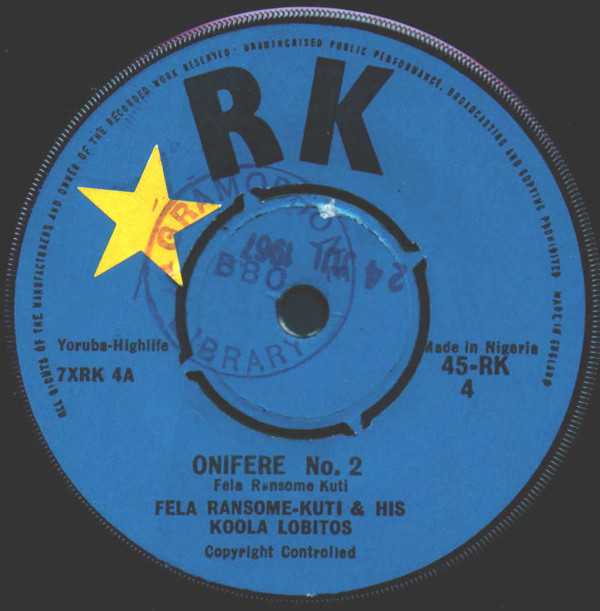 | Album: 1 of 49 Title: Fela Ransome Kuti and His Koola Lobitos Released: 1965 Tracks: 11 Duration: 00:00 Scroll: Up Down Top Bottom 25% 50% 75% AlbumCover | 1 Signature Tune (?) 2 Its Highlife Time (?) 3 Lagos Baby (?) 4 Omuti (?) 5 Ololufe (?) 6 Arabas Delight (?) 7 Wa dele (?) 8 Lai Se (?) 9 Mi o Mo (?) 10 Obirin le (?) 11 Omo Ejo (?) |
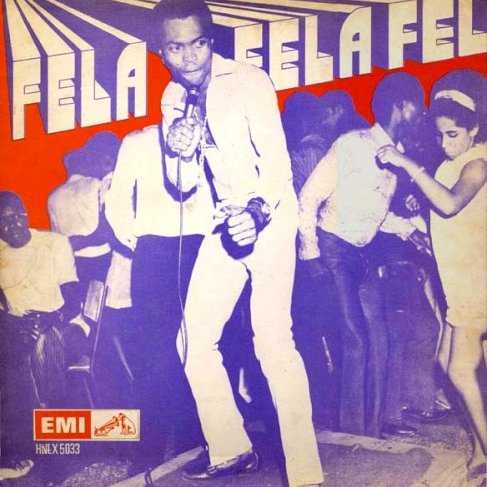 | Album: 2 of 49 Title: Fela Fela Fela Released: 1969 Tracks: 10 Duration: 46:01 Scroll: Up Down Top Bottom 25% 50% 75% AlbumCover | 1 My Ladys Frustration (07:01) 2 Viva Nigeria (03:46) 3 Obe (Stew) (03:13) 4 Ako (02:41) 5 Witchcraft (05:26) 6 Wayo (03:28) 7 Lover (06:09) 8 Funky Horn (04:43) 9 Eko (04:13) 10 This Is Sad (05:21) |
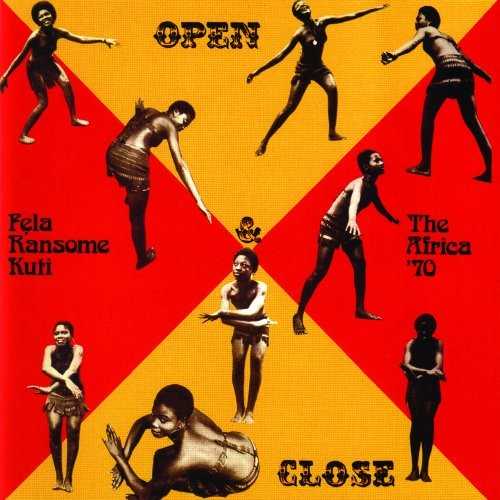 | Album: 3 of 49 Title: Open & Close Released: 1971 Tracks: 4 Duration: 40:39 Scroll: Up Down Top Bottom 25% 50% 75% Spotify Allmusic AlbumCover | 1 Open & Close (15:02) 2 Swegbe and Pako (1) (03:50) 3 Suegbe & Pako (12:30) 4 Gbagada Gbogodo (09:17) |
| Open & Close : Allmusic album Review : Another long-thought-lost gem from the Fela Anikulapo Kuti archives, Open & Close was originally released in 1971 and, in the manner of He Miss Road and Felas London Scene, is a total groove-fest loaded to the gills with raucous horn blowing, ferocious percussion (once again, Tony Allen take a bow), and song lengths over ten minutes. By this point, Fela could do no wrong when it came to recording; Afro-beat dissenters will claim that there is a trance-inducing similarity to much of Felas 70s recorded output, that the grooves arent enough to make the songs distinctive enough on their own. Thats true of some of his later recordings (like in the mid- to late 80s), but at this point he was still breathing fire and the band was in top form. Perhaps the distinguishing factors of records like Open & Close and some of Felas other 70s releases are that as much as he liked to ride a groove, he also liked to disrupt it, twist it and turn it, reshape it, only to bring it back to its original shape. There was less of that later in his career. | ||
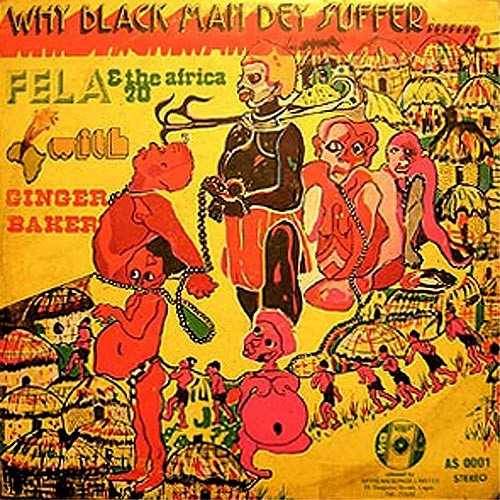 | Album: 4 of 49 Title: Why Black Man Dey Suffer Released: 1971 Tracks: 2 Duration: 28:07 Scroll: Up Down Top Bottom 25% 50% 75% Wikipedia Allmusic AlbumCover | 1 Why Black Man Dey Suffer (15:12) 2 Ikoyi Mentality Versus Mushin Mentality (12:55) |
| Why Black Man Dey Suffer : Allmusic album Review : Pioneering musician, activist, and bandleader Fela Kuti is the first word in Afro-beat, making such strides in the genre over the course of his career that his contributions are foundational and nothing less than legendary. Why Black Man Dey Suffer is a relatively early chapter in the Fela discography, originally recorded in 1971. Put to tape with early band Africa 70 and Cream drummer/Afro-beat enthusiast Ginger Baker on board as well, the record is made up of two extensive, repetitive, and loping pieces. The rhythmic title track is a blueprint of early Afro-beat and "Ikoyi Mentality Versus Mushin Mentality" is a deep groove of burning horns and fearless percussion. | ||
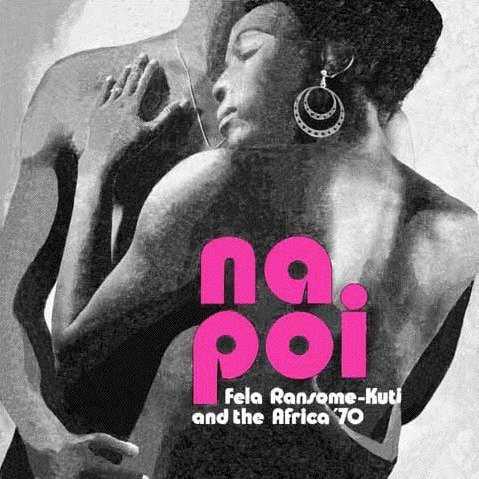 | Album: 5 of 49 Title: Na Poi Released: 1971 Tracks: 3 Duration: 07:33 Scroll: Up Down Top Bottom 25% 50% 75% Spotify TrackSamples Allmusic AlbumCover | 1 Na Poi (part 1) (?) 2 Na Poi (part 2) (?) 3 You No Go Die ... Unless (07:33) |
| Na Poi : Allmusic album Review : This album is somewhat of an anomaly for Fela Kuti. Accompanied as always by the Africa 70 band, Kuti temporarily abandons his tradition of one song extending over an entire LP side -- although he hasnt strayed too far from form -- as the A-side track extends over basically one-and-a-half sides with the shorter funky rave "You No Go Die.....Unless" completing the B-side. In addition to that slight variance, the structure of Kutis delivery, as well as the explicitly sexual intonation in the subject matter of "Na Poi" stray from tradition. The title song has somewhat of a history in that it was recorded and issued twice before. The first version from 1972 has not been reissued domestically; however, Yellow Fever (1976) updated the track, which carried the apt moniker "Na Poi 75." The following year the composition was revisited to comprise a lengthy version. In essence, the track is a sexual guide set to music. As such, it features both spoken narration as well as sung lyrics. "Na Poi"s rhythms churn and grind through several notable movements -- including a spirited percussion section and several tight horn arrangements. These hark back to the same type of perpetual funk that became the cornerstone of Parliament and Funkadelic. Initially, the repercussions of such blatant sexuality resulted in the track being banned by the Nigerian Broadcasting Company -- although when the song was reissued in 1975 it snuck back on the air as the new version had an ever so slightly different name. "You No Go Die.....Unless" is much in the same spirit as James Browns hard-driven funk musings. From Kutis impassioned vocals to the upbeat syncopation of the rhythm, this track contains many obvious parallels between the mid-70s stateside funk movement and that of concurrently popular African music. The incorporation of the Africa 70 horn section -- which is heavily featured during the bridges -- also provides a much thicker punctuation to Kutis vocals. Lyrically, the song deals with the urban sprawl that was beginning to occur in Lagos -- in many ways a social observation on par with Marvin Gayes "Inner City Blues" or Stevie Wonders "Living for the City." | ||
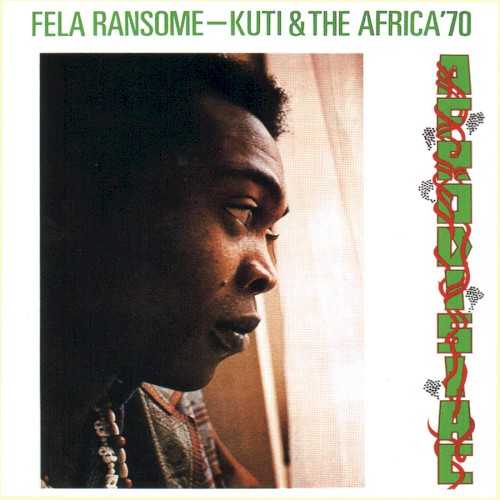 | Album: 6 of 49 Title: Afrodisiac Released: 1972 Tracks: 4 Duration: 39:52 Scroll: Up Down Top Bottom 25% 50% 75% Spotify Allmusic AlbumCover | 1 Alu Jon Jonki Jon (12:41) 2 Jeun Ko Ku (Chopn Quench) (07:14) 3 Eko Ile (06:41) 4 Je Nwi Temi (Dont Gag Me) (13:15) |
| Afrodisiac : Allmusic album Review : The four (lengthy, as usual) songs occupying this album were originally recorded in Nigeria as 45 rpm releases. Afrodisiac consists of re-recordings of these, done in London in the early 70s. While its true that Fela Kutis albums from this period are pretty similar to each other, in their favor theyre not boring. These four workouts, all sung in Nigerian, are propulsive mixtures of funk and African music, avoiding the homogeneity of a lot of funk and African records of later vintage, done with nonstop high energy. The interplay between horns, electric keyboards, drums, and Kutis exuberant vocals gives this a jazz character without sacrificing the earthiness that makes it danceable as well. "Jeun Ko Ku (Chopn Quench)" became Kutis first big hit in Nigeria, selling 200,000 copies in its first six months in its initial version. | ||
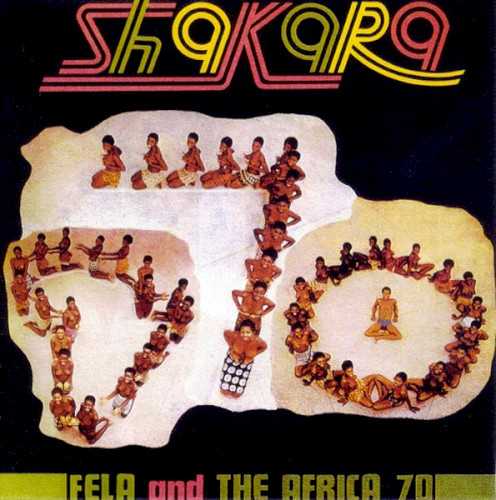 | Album: 7 of 49 Title: Shakara Released: 1972 Tracks: 2 Duration: 27:13 Scroll: Up Down Top Bottom 25% 50% 75% Allmusic AlbumCover | 1 Shakara (Oloje) (13:26) 2 Lady (13:47) |
| Shakara : Allmusic album Review : Fela Kuti was often described as "the James Brown of Africa," but one could also argue that he was Africas equivalent of Miles Davis or John Coltrane. Truth be told, either description is valid. Kuti was highly eclectic, and his innovative, visionary music contained elements of funk/soul, jazz, and blues, as well as African music. That eclectic spirit proves to be a major asset on Shakara, which consists of two 13-minute performances by Kutis Africa 70 band: "Lady" and "Shakara (Oloie)." Performed in English, "Lady" finds Kuti criticizing modern African women in a humorous way for becoming what he sees as overly westernized and embracing a western view of feminism. You might agree or disagree with the songs viewpoint, but the groove and the beat are irresistible. Equally addictive -- and equally sarcastic -- is "Shakara (Oloje)," which is sung in both Yoruba and English and makes fun of the type of pompous, loud-mouthed braggarts who can never make good on their empty boasts. | ||
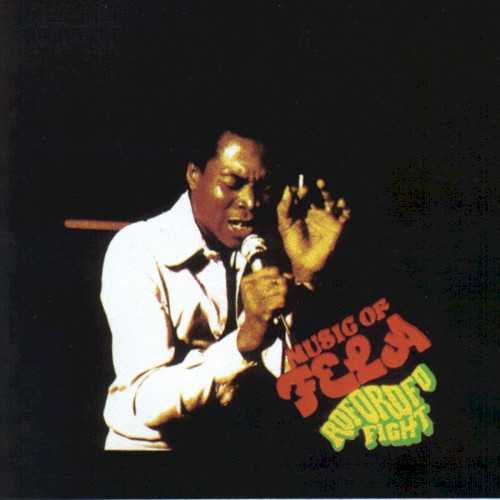 | Album: 8 of 49 Title: Roforofo Fight Released: 1972 Tracks: 6 Duration: 1:18:20 Scroll: Up Down Top Bottom 25% 50% 75% Spotify Wikipedia Allmusic AlbumCover | 1 Roforofo Fight (15:41) 2 Go Slow (17:24) 3 Question Jam Answer (13:40) 4 Trouble Sleep Yanga Wake Am (12:05) 5 Shenshema (09:09) 6 Ariya (10:18) |
| Roforofo Fight : Allmusic album Review : Its true that Fela Kutis early-70s records tend to blur together with their similar groupings of four lengthy Afro-funk-jazz cuts. In their defense, it must be said that while few artists can pull off similar approaches time after time and continue to make it sound fresh, Kuti is one of them. Each of the four songs on the 1972 album Roforofo Fight clocks in at 12 to 17 minutes, and theres a slight slide toward more 70s-sounding rhythms in the happy-feet beats of the title track and the varied yet rock-solid drums in "Go Slow." Theres just a hint of reggae in "Trouble Sleep Yanga Wake Am," in the pace, vocal delivery, ethereal keyboards, and lilting yet dramatic minor melodic lines. The James Brown influence is strongly heard in the lean, nervous guitar strums of "Question Jam Answer," and the horns cook in a way that they might have had Brown been more inclined to let his bands go into improvisational jams. | ||
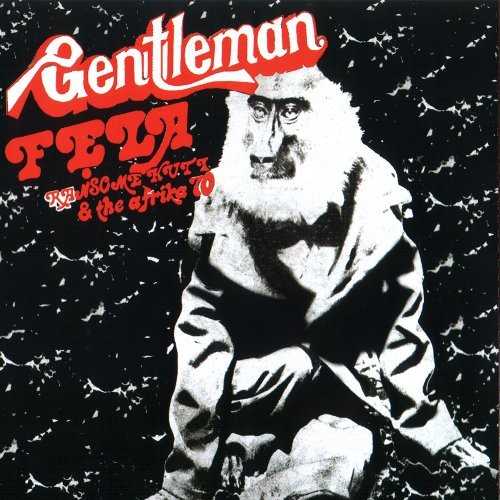 | Album: 9 of 49 Title: Gentleman Released: 1973 Tracks: 3 Duration: 31:01 Scroll: Up Down Top Bottom 25% 50% 75% Spotify Allmusic AlbumCover | 1 Gentleman (14:41) 2 Igbe (Na Shit) (08:12) 3 Fefe Naa Efe (08:08) |
| Gentleman : Allmusic album Review : Gentleman is both an Africa 70 and Afro-beat masterpiece. High marks go to the scathing commentary that Fela Anikulapo Kuti lets loose but also to the instrumentation and the overall arrangements, as they prove to be some of the most interesting and innovative of Felas 70s material. When the great tenor saxophone player Igo Chico left the Africa 70 organization in 1973, Fela Kuti declared he would be the replacement. So in addition to bandleader, soothsayer, and organ player, Fela picked up the horn and learned to play it quite quickly -- even developing a certain personal voice with it. To show off that fact, "Gentleman" gets rolling with a loose improvisatory solo saxophone performance that Tony Allen eventually pats along with before the entire band drops in with classic Afro-beat magnificence. "Gentleman" is also a great example of Felas directed wit at the post-colonial West African sociopolitical state of affairs. His focus is on the Africans that still had a colonial mentality after the Brits were gone and then parallels that life with his own. He wonders why his fellow Africans would wear so much clothing in the African heat: "I know what to wear but my friend dont know" and also points out that "I am not a gentleman like that!/I be Africa man original." To support "Gentleman," the B-side features equally hot jazzy numbers, "Fefe Naa Efe" and "Igbe," making this an absolute must-have release. [In 2000, MCA released Confusion and Gentleman as a two-fer.] | ||
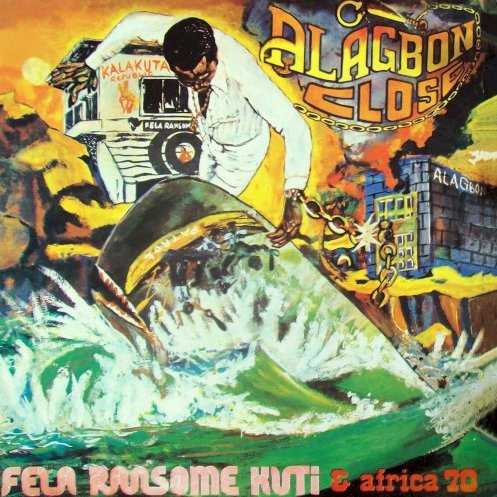 | Album: 10 of 49 Title: Alagbon Close Released: 1974 Tracks: 2 Duration: 28:17 Scroll: Up Down Top Bottom 25% 50% 75% Allmusic AlbumCover | 1 Alagbon Close (16:58) 2 I No Get Eye for Black (11:19) |
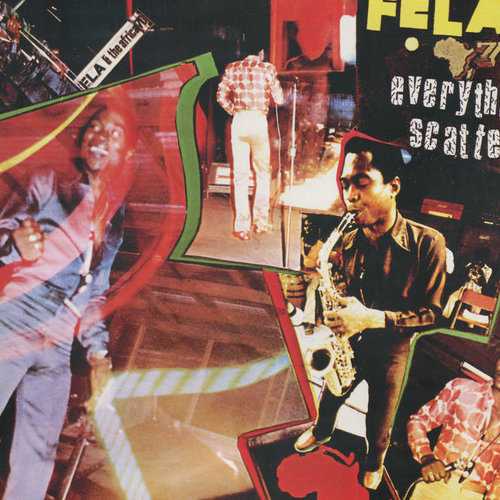 | Album: 11 of 49 Title: Everything Scatter Released: 1975 Tracks: 2 Duration: 29:49 Scroll: Up Down Top Bottom 25% 50% 75% Allmusic AlbumCover | 1 Everything Scatter (14:38) 2 Who No Know Go Know (15:11) |
| Everything Scatter : Allmusic album Review : Perhaps one risks charges of artistic insensitivity by saying so, but by the mid-70s Kutis records were becoming predictable and formulaic to an extent. It was a good formula, played and sung with conviction, and if any individual record or two were the only evidence of his work, they would be properly respected as important music. However, it isnt too easy to differentiate, in large degrees, between his numerous releases of the era that comprised two (and exactly two) ten- to 15-minute songs. These are built from several minutes of instrumental interplay between electric keyboards, horns, and percussion to a vocal declaiming general platitudes about injustice and African identity, with energetic contributions from backup singers. Everything Scatter has two such songs. The ten-minute title track posits Kuti and his followers versus the status quo. The 15-minute "Who No Know Go Knows" strikes a more relaxed groove in its call for African unity. | ||
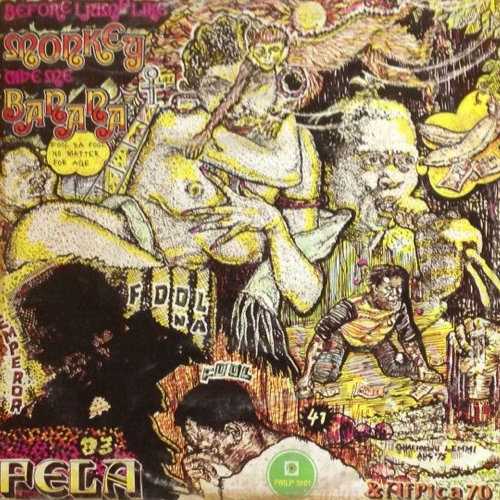 | Album: 12 of 49 Title: Before I Jump Like Monkey Give Me Banana Released: 1975 Tracks: 2 Duration: 24:34 Scroll: Up Down Top Bottom 25% 50% 75% AlbumCover | 1 Monkey Banana (11:36) 2 Sense Wiseness (12:58) |
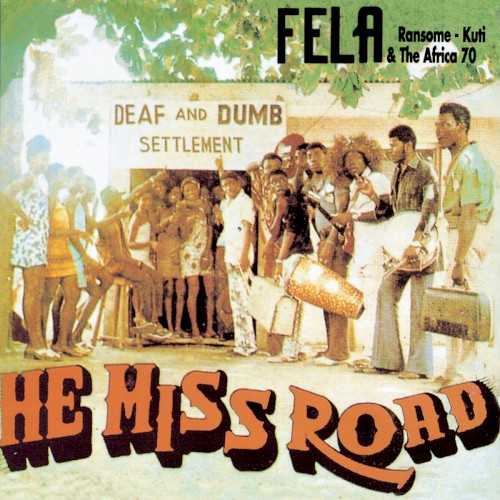 | Album: 13 of 49 Title: He Miss Road Released: 1975 Tracks: 3 Duration: 39:39 Scroll: Up Down Top Bottom 25% 50% 75% Spotify Allmusic AlbumCover | 1 He Miss Road (10:47) 2 Monday Morning in Lagos (11:15) 3 Its Not Possible (17:36) |
| He Miss Road : Allmusic album Review : He Miss Road was produced by none other than Ginger Baker, who was a semi-regular jamming partner of Fela Kutis as well as a close friend. And the tunes Fela wrote for this platter are wild, cosmic, sexy as hell, and deeply saturated in funk à la James Brown. The B-3 solo at the beginning of the title track is simply a device for inviting the band in. The B-3 is way up in the mix, supercharged. The echo effects Baker used on the organ and the horns add a nice touch and create a different textural quality, one that is spacious, to be sure, but still rooted in the shamanic repetition as the riff goes on forever no matter what instruments enter or leave the mix. The vocals show up midway through as everything gets tense and explodes. "Monday Morning in Lagos" is deep, dark, swirling Afro-funk. Its moody, spooky, and its organ line just stitches the whole groove together. The final cut, "Its No Promise," is pure Nigerian trance music. The longest track here, its also the most abstract. Its held together by Tony Allens drumming and the popping bassline by Franco Aboddy. This is one of Felas cookers, an album from his most creative period, and it reigns among the best in his extensive catalog. | ||
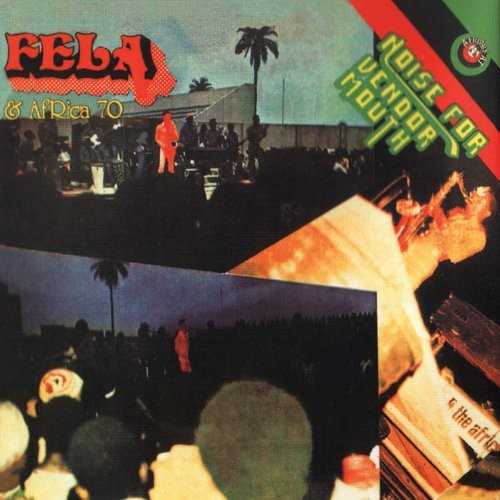 | Album: 14 of 49 Title: Noise for Vendor Mouth Released: 1975 Tracks: 2 Duration: 00:00 Scroll: Up Down Top Bottom 25% 50% 75% Allmusic AlbumCover | 1 Noise for Vendor Mouth (?) 2 Mattress (?) |
| Noise for Vendor Mouth : Allmusic album Review : One of several 1975 Fela Kuti albums that contains two ten- to 15-minute tracks, Noise for Vendor Mouth follows the musicians usual path during the period. Extended instrumental sections with interplay between keyboards, horns, and percussion bracket call-and-response vocals with brusque commentary on government repression and other social issues. It sounds exhilarating taken an album or two at a time, though in the context of Kutis discography, individual releases are hard to single out as highlights, or indeed, being that different from each other. Here "Noise for Vendor Mouth" puts some more emphasis on the choppy, lean, funk-ish guitars than some Kutis other cuts. "Mattress" goes a little further afield in its controversial subject matter, here reflecting his polygamous lifestyle, though musically its in line with his usual recordings from the era. | ||
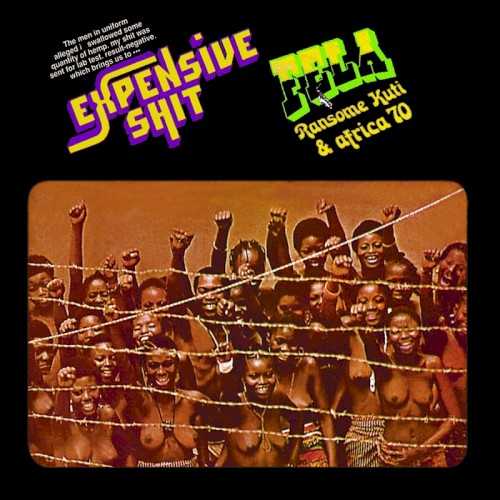 | Album: 15 of 49 Title: Expensive Shit Released: 1975 Tracks: 2 Duration: 24:15 Scroll: Up Down Top Bottom 25% 50% 75% Wikipedia Allmusic AlbumCover | 1 Expensive Shit (13:13) 2 Water No Get Enemy (11:02) |
| Expensive Shit : Allmusic album Review : This disc is an overt response to the consistent harassment afflicting Fela Kutis Kalakuta Republic in the early 70s under the oppressive Lagos authorities. The title track is a direct reference to an actual incident that occurred in which the cops planted a marijuana cigarette on Kuti -- who promptly swallowed it and therefore destroyed any evidence. He was then held until he could pass the drugs from his system -- which miraculously did not occur when his fecal sample was then sent for analysis, thanks to some help from his fellow inmates. Because of the costs incurred during this debacle, Kuti proclaimed his excrement as Expensive Shit. Musically, the Afro-funk and tribal rhythms that Kuti and his Africa 70 put down can rightfully be compared to that of James Brown or even a George Clinton-esque vibe. The beats are infectious with a hint of Latin influence, making the music nearly impossible to keep from moving to. Although the band is large, it is also remarkably tight and malleable enough to accompany and punctuate Kutis vehement and indicting lyrics. The nature of what Kuti says, as well as infers, amounts to much more than simply whining or bad-rapping the law. His witty and thoughtful raps not only relate his side of the incident, but do so with tongue-in-cheek humor -- such as the statement that his oppressors must really enjoy his feces because they want to examine it so urgently. Yet, he tries to stay away from it, for somewhat obvious reasons. The albums B-side contains the metaphysical "Water No Get Enemy." This is a comparatively jazzy piece, with Africa 70 again exploring and stretching out its impulsive beats behind Kutis singing. The track features some of his finest and most inspired keyboard work as well. He weaves hypnotic and ethereal electric piano lines over the earthy-sounding brass section. The laid-back groove works well in contrast to the manic tempo of "Expensive Shit." | ||
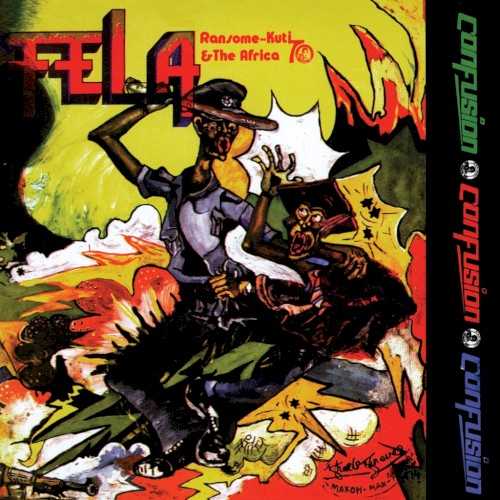 | Album: 16 of 49 Title: Confusion Released: 1975 Tracks: 2 Duration: 25:39 Scroll: Up Down Top Bottom 25% 50% 75% Allmusic AlbumCover | 1 Confusion, Part 1 (14:11) 2 Confusion, Part 2 (11:28) |
| Confusion : Allmusic album Review : Fela Kutis 1975 Confusion shows him and Africa 70 at the heights of instrumental prowess and ambiguous jibes (the stabs are about to get a bit more direct and heated with 1977s Zombie). "Confusion" begins with an unusual free jazz interplay between Fela on organ and drummer Tony Allen that has the presence of 2001: A Space Odyssey in its omnipresent drama. Then the group falls into a lengthily mid-tempo Afro funk that plays with a sureness that only comes from skilled musicians and a dictator-like leader; here is the formula that had made Fela a genius: Once he has the listener (or the crowd -- as all of his songs were originally meant to entertain and educate his audiences at the Shrine) entranced in his complex (and at the same time, deceptively simple) arrangements of danceable grooves, he hits them with what he wants to say. "Confusion" is a comment on the general condition of urban Nigeria (Lagos, in particular). Fela uses traffic jams, no fewer than three dialects, and a multitude of currencies that make trading difficult to complete the allusion to the general post-colonial confusion of a Nigeria lacking in infrastructure and proper leadership. Confusion is a highly recommended 25-minute Afro-beat epic. [In 2000, MCA released Confusion and Gentleman as a two-fer.] | ||
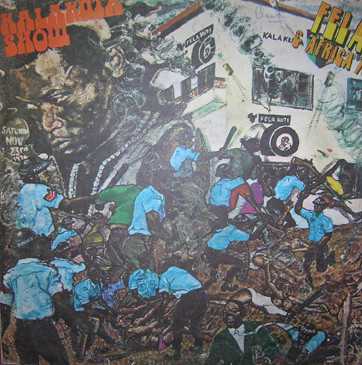 | Album: 17 of 49 Title: Kalakuta Show Released: 1976 Tracks: 2 Duration: 32:34 Scroll: Up Down Top Bottom 25% 50% 75% Spotify Allmusic AlbumCover | 1 Kalakuta Show (14:30) 2 Dont Make Garan Garan (18:04) |
| Kalakuta Show : Allmusic album Review : By the time of 1976s Kalakuta Show, Fela Kutis releases seemed not so much like records as ongoing installments in one long jam, documenting the state of mind of Nigerias leading contemporary musician and ideological/political dissenter. Thus, any one album works better on its own than it does when it has to bear comparison with the rest of his mountainous output. The track "Kalakuta Show" was unexceptional by his own standards, though it was a respectable lock-groove song that followed the usual graph of Kutis song progressions. The lyrics, at any rate, go far outside the usual funk/pop spectrum, detailing his harassment at the hands of the Nigerian police. "Dont Make Garan Garan" was musically more effective, particularly in its use of the artists characteristically eerie, out-of-sync-sounding electric keyboards. | ||
 | Album: 18 of 49 Title: Zombie Released: 1976 Tracks: 3 Duration: 34:36 Scroll: Up Down Top Bottom 25% 50% 75% Spotify Wikipedia Allmusic AlbumCover | 1 Zombie (12:26) 2 Monkey Banana (11:36) 3 Everything Scatter (10:33) |
| Zombie : Allmusic album Review : Zombie was the most popular and impacting record that Fela Kuti & Africa 70 would record -- it ignited the nation to follow Felas lead and antagonize the military zombies that had the population by the throat. Fela is direct and humorous in his attack as he barks out commands to the soldiers like: "Attention! Double up! Fall In! Fall out! Fall down! Get ready!" Meanwhile, his choir responds with "Zombie!" in between each statement. Since the groove was so absolutely contagious, it took the nation by storm: People in the street would put on a blank stare and walk with hands affront proclaiming "Zombie!" whenever they would see soldiers. If "Zombie" caught the attention of the populous it also cought the attention of the authority figures -- this would cause devastating personal and professional effects as the Nigerian government came down on him with absolute brute force not long after the release of this record. Also included are "Monkey Banana," a laid-back groove that showcases drummer Tony Allens mastery of the Afro-beat, and "Everything Scatter," a standard mid-tempo romp. Both songs are forgetful in relation to "Zombie," but this is still an essential disc to own for the title track alone. | ||
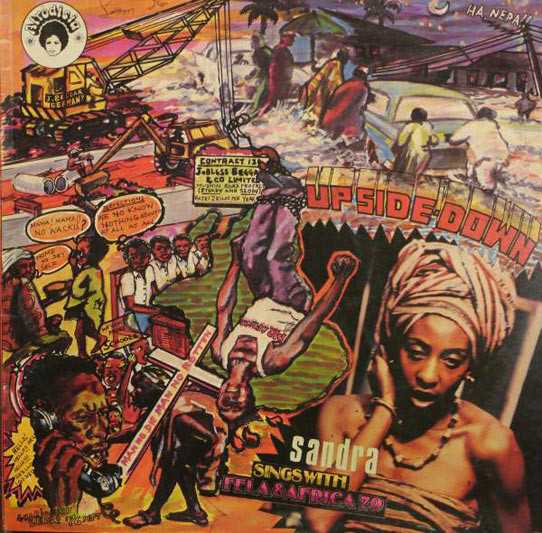 | Album: 19 of 49 Title: Up Side Down Released: 1976 Tracks: 2 Duration: 29:22 Scroll: Up Down Top Bottom 25% 50% 75% AlbumCover | 1 Upside Down (14:45) 2 Go Slow (14:37) |
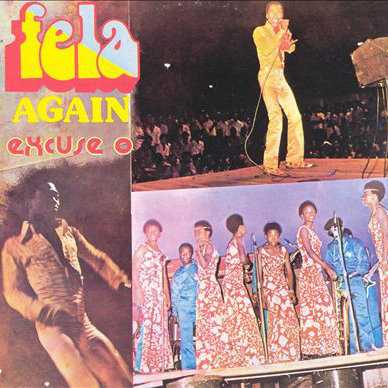 | Album: 20 of 49 Title: Excuse O Released: 1976 Tracks: 2 Duration: 30:09 Scroll: Up Down Top Bottom 25% 50% 75% Spotify TrackSamples Allmusic AlbumCover | 1 Excuse O (13:35) 2 Mr. Grammarticalogylisatitionalism Is the Boss (16:34) |
| Excuse O : Allmusic album Review : By the mid-70s, Kutis albums had essentially become extended singles in the LP format, with two songs in the 10- to 15-minute range occupying entire sides of the release. The 13-minute "Excuse O" is the title side of this album. Its not much different than his usual excursions into Afro-funk-jazz fusion from the era, though at this point he was moving into rhythms that were more jittery and African-sounding than those he had used on many early-70s efforts. "Mr. Grammarticalogylisationalism Is the Boss" is his bid for the "longest word used in a song title" contest. The novelty of that title aside, its one of the better cuts from his mid-70s discography, with remarkably spooky, effective organ, a slow ominous groove, and a blunt critique of Africas educational system. . | ||
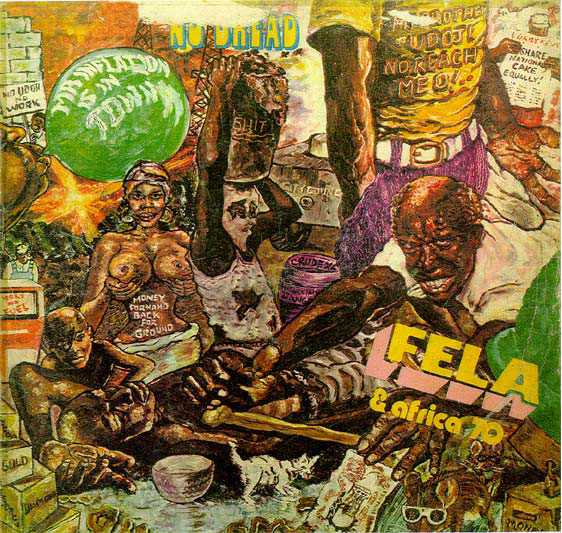 | Album: 21 of 49 Title: No Bread Released: 1976 Tracks: 2 Duration: 30:16 Scroll: Up Down Top Bottom 25% 50% 75% AlbumCover | 1 No Buredi (No Bread) (14:05) 2 Unnecessary Begging (16:11) |
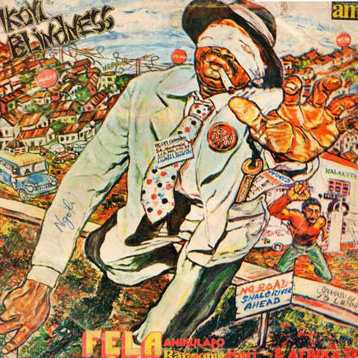 | Album: 22 of 49 Title: Ikoyi Blindness Released: 1976 Tracks: 2 Duration: 29:17 Scroll: Up Down Top Bottom 25% 50% 75% Allmusic AlbumCover | 1 Ikoyi Blindness (15:06) 2 Gba Mi Leti Ki Ndolowo (Slap Me Make I Get Money) (14:11) |
| Ikoyi Blindness : Allmusic album Review : Ikoyi Blindness was a middle-of-the-pack release in a sea of mid-70s Kuti records that featured two songs and about a half-hours worth of music. The rhythms were a little tighter and more highlife-influenced than they had been on albums from earlier in the decade. "Ikoyi Blindness" itself was pretty typical of efforts from the period, both in a structure that built up to call-and-response vocal, and in a taut two-chord melodic base. "Gba Mi Leti Ki NDolowo (Slap Me Make I Get Money)" is a little more interesting due to its choppier rhythms, more vibrant percussion, stuttering low guitar riff, and extended haunting electric keyboard lines. | ||
 | Album: 23 of 49 Title: Yellow Fever Released: 1976 Tracks: 2 Duration: 28:54 Scroll: Up Down Top Bottom 25% 50% 75% Allmusic AlbumCover | 1 Yellow Fever (15:22) 2 Na Poi 75 (13:32) |
| Yellow Fever : Allmusic album Review : The entire mid-70s found Fela Kuti and his Afrika 70 really honing in on their signature sound. Yellow Fever, released in 1976, sits right up there with No Agreement (1977) and Confusion (1975) both in terms of quality of the groove and Felas tact in putting out his message. "Yellow Fever" opens with a couple of measures of guitar and bass interplay that sets up the standard funk-jazz vamp that will prod the entire length. The horn solos are reaching, explosive, and (though the word is overused) funky. Fred Wesley and Maceo Parker have some tough competition here, as these guys are unwielding in their voice. After eight minutes of instrumental eminence, Fela makes his own voice heard and gets to the meat of his product. The words speak of the strange practice of Africans lightening their skin -- this idea just doesnt jive with Felas strong pan-African sentiments. As he gets progressively worked up, the choir responds to him exemplifying the idea and the vibe. Once Fela feels hes got his point across, he just lets the musicians have their fun until the end of this 15-minute rollick. An unbelievable and hard-hitting groove opens up "Na Poi" and slams in with absolute genius. This is actually another version of the same song from 1972. "Na Poi," banned by the Nigerian Broadcasting Company due to its sexual content, makes one wonder -- what was really going on in the Kalakuta Republic (his walled-in residence)? The instrumentation of "Na Poi" that began as genius settles into the familiar and works itself out until, once again, Fela decides to get down and literally dirty. This is an entertaining piece, but it doesnt really hold up to the rest of his material. [MCA released Yellow Fever and the full-length Na Poi as a two-fer in 2000.] | ||
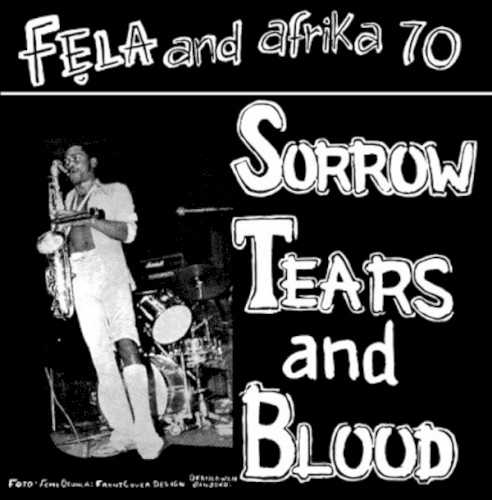 | Album: 24 of 49 Title: Sorrow Tears and Blood Released: 1977 Tracks: 2 Duration: 23:58 Scroll: Up Down Top Bottom 25% 50% 75% TrackSamples Allmusic AlbumCover | 1 Sorrow Tears and Blood (10:16) 2 Colonial Mentality (13:42) |
| Sorrow Tears and Blood : Allmusic album Review : Sorrow Tears and Blood (1977) accurately depicts the trail left in the wake of the February 18, 1977, raid by 1,000 armed Nigerian army men on Fela Kuti and his Kalakuta Republic. In keeping with the format upheld on a majority of Kutis long players, this LP contains a pair of extended works, featuring one title per side. In contrast to the hard-edged and aggressive Afro-funk that Kuti and his Africa 70 became synonymous with, both the A-side title track and B-side, "Colonial Mentality," are seemingly staid, in light -- or perhaps because -- of the cruel state-sponsored attacks that he and his extended family suffered. "Sorrow Tears and Blood" is neither a full-blown, uptempo funk drone nor a somber dirge. The even-handed, midtempo groove trots along at a steady pace and features some comparatively sedate sax work from Kuti. Even the instrumental introduction -- which has been known to clock in at over five minutes -- is reduced to well under three. His lyrics are starkly direct -- "Everybody run, run, run/Everybody scatter, scatter/Some people lost some bread/Some people just die" -- yet the emotive center is gone. Perhaps this is the result of fear, shellshock, or a combination of the two. Kutis words, however, remain as indicting as ever: "Them leave sorrow, tears, and blood/Them regular trademark." "Colonial Mentality" returns to a more seething and slinky musicality. The dark and brooding bassline undulates beneath a brass-intensive Africa 70. Rarely has Kutis musical arrangements so perfectly imaged James Browns J.B.s or Barry Whites Love Unlimited Orchestra. The message is delivered as a fable, demonstrating that it is the individuals who live in a stifling "Colonial Mentality" who are the slaves. His preface, stating that the colonial man had released them yet they refuse to release themselves, sets out to prove that slavery is a continual and concurrent state of mind for Africans. | ||
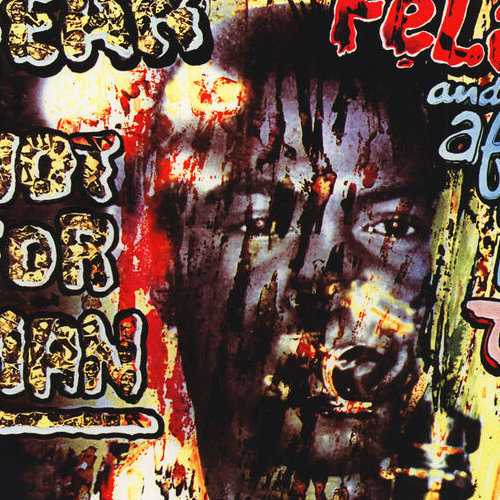 | Album: 25 of 49 Title: Fear Not for Man Released: 1977 Tracks: 2 Duration: 29:39 Scroll: Up Down Top Bottom 25% 50% 75% Allmusic AlbumCover | 1 Fear Not for Man (14:14) 2 Palm Wine Sound (15:25) |
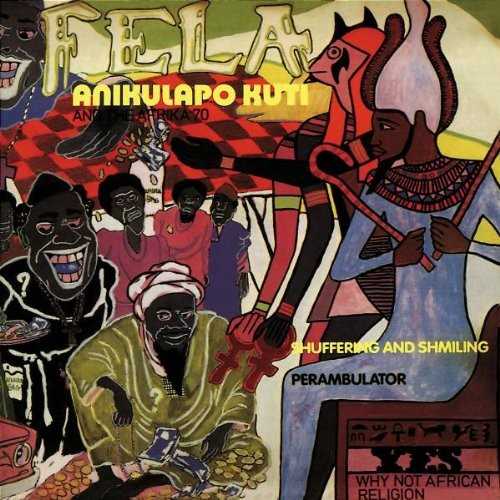 | Album: 26 of 49 Title: Shuffering and Shmiling Released: 1977 Tracks: 2 Duration: 21:59 Scroll: Up Down Top Bottom 25% 50% 75% Allmusic AlbumCover | 1 Shuffering and Shmiling (Instrumental) (09:47) 2 Shuffering and Shmiling (Vocal) (12:12) |
| Shuffering and Shmiling : Allmusic album Review : After the 1977 police attack on Felas Kalakuta Republic, where his mother and about 80 members of his entourage and band were injured and arrested, he set out to light a fire underneath the authority figures and his various other enemies that were causing him and, in his eyes, the people of Nigeria to suffer in the form of harassment, oppression, and economic devastation. Shuffering and Shmiling is one of those comments. While continuing along in his tradition of savvy instrumental innovation, "Shuffering and Shmiling" plays out with the same intensity and voracious soloing that mark other great Africa 70 performances like Confusion, Gentleman, and No Agreement; but the point of departure here is the outward remarks he makes on a touchy topic: religion. Fela had become increasingly concerned about the growing influence of non-traditional religions fracturing African countries. He believed that these divisions had created a population unable to unify and stand up for themselves and instead had them living in conditions that forced "them go pack themselves in like sardine (into a bus): Suffering and smiling," and without trying to change things he says they "Suffer suffer for world/Enjoy for heaven." Shuffering and Shmiling is another highly recommended Fela Kuti and Africa 70 release. | ||
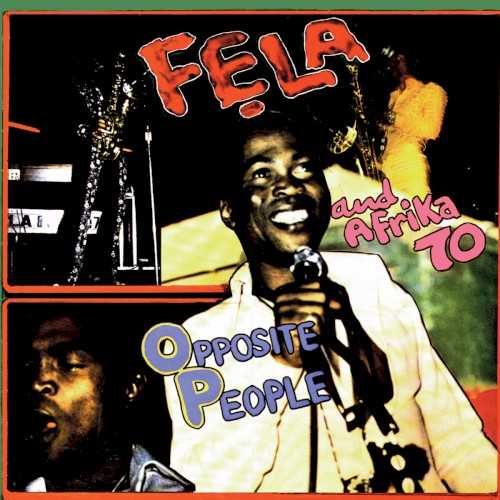 | Album: 27 of 49 Title: Opposite People Released: 1977 Tracks: 2 Duration: 33:21 Scroll: Up Down Top Bottom 25% 50% 75% Spotify Allmusic AlbumCover | 1 Opposite People (16:39) 2 Equalisation of Trouser and Pant (16:42) |
| Opposite People : Allmusic album Review : Pioneering musician, activist, and bandleader Fela Kuti is the first word in Afro-beat, making such strides in the genre over the course of his career that his contributions are foundational and nothing less than legendary. Released in 1977, Opposite People finds Fela and his band Afrika 70 riding a fever-pitched groove for the customary two side-long extended jams that made up most of Felas classic output. The title track builds for 11 or more minutes before Kuti comes in with a sociopolitical lecture in sung-scatted form, and second cut "Equalisation of Trouser and Pant" is a slinkier affair, with hints of greasy rock guitar and wandering electronic keyboard tones. | ||
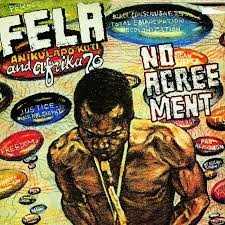 | Album: 28 of 49 Title: No Agreement Released: 1977 Tracks: 2 Duration: 31:09 Scroll: Up Down Top Bottom 25% 50% 75% Spotify Allmusic AlbumCover | 1 No Agreement (15:36) 2 Dog Eat Dog (15:33) |
| No Agreement : Allmusic album Review : Recorded in 1977, No Agreement follows the Afro-beat template to a masterful level: amazingly catchy guitar lines that replicate a bass guitar in their construction, a second guitarist to add some JBs funk power, driving horn section proclamations, intricate saxophone, trumpet and organ improv solos, and then Fela Anikulopo Kutis wit and message for the people. Even though Fela had vowed to speak his mind, he turns in a song where he proclaims to keep his mouth shut if it means that he will harm his brothers and sisters in the population (not that he actually does, as some of his most scathing songs have yet to come). "No Agreement" is decidedly some of the most interesting instrumentation that he had turned in. With help from Art Ensemble of Chicago trumpeter extradordinare Lester Bowie (Bowie turned in a tenure of about a year with Fela), the solos are magically inspired and the rhythm section rolls on with the power of a steamroller. "Dog Days," the instrumental B-side, sounds more like "No Agreement" part two; it does, however, carry its own weight -- again with the help from Bowie. [In 2000, MCA released No Agreement with Shuffering and Shmiling as a two-fer.] | ||
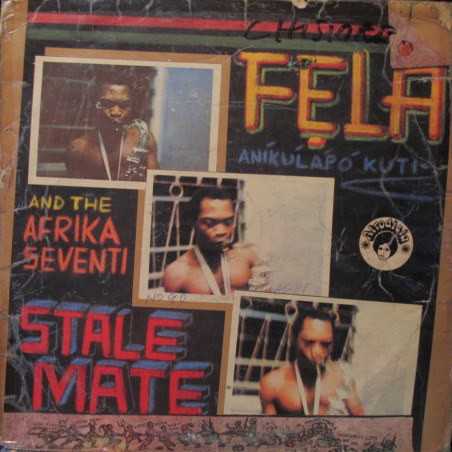 | Album: 29 of 49 Title: Stalemate Released: 1977 Tracks: 2 Duration: 00:00 Scroll: Up Down Top Bottom 25% 50% 75% Allmusic AlbumCover | 1 Stalemate (?) 2 African Message (Dont Worry About My Mouth-o) (?) |
| Stalemate : Allmusic album Review : Despite a massive attack by 1,000 armed Nigerian army men on his Kalakuta Republic compound on February 18, 1977, Fela Kuti, accompanied by his Africa 70, resumed his prolific musical output -- which yielded in excess of half-a-dozen long-players a year since 1975. While the exact recording date is not documented, it could easily be surmised that Stalemate -- like Opposite People -- was recorded prior to the incident. Another correlation between the two releases is that the subject matter is more social than political in content. In keeping with tradition, the album Stalemate consist of two extended pieces -- one per side. The title track has a mid-tempo trance groove that bends and yields to Kutis call and response with Africa 70. After a lengthy instrumental introduction -- thoroughly establishing the buoyant rhythm -- Kuti begins his half-spoken/half-sung observations. His subject matter, as is often the case, deals with relationships between people and using logic to avoid conflict. One valuable lesson that can be derived from "Stalemate" is keeping ones opinions to ones self until all facts have been presented -- thus, avoiding a stalemate. The B-side track contains an equally funk-driven piece, whose subject matter is steeped in native African tradition. The moral struggle between convention and invention collide on "Dont Worry About My Mouth O..." Kutis rap explains the heritage and preference in the African "chewing stick" versus the toothbrush/toothpaste combination so popular in most of the world. The rear cover even includes photos of Kuti using the said "chewing stick." He also makes a few clever analogies between the healthy mouth and the things that come out of it. [In 2000, Stalemate was reissued on CD coupled with another 1977 release, Fear Not for Man -- which contains the rare instrumental "Palm Wine Sound."] | ||
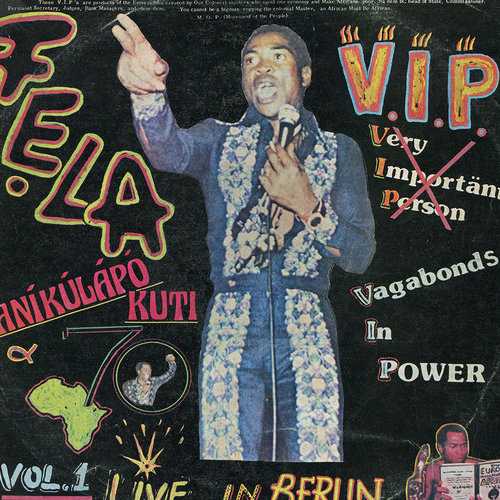 | Album: 30 of 49 Title: V.I.P. (Vagabonds in Power) Released: 1979 Tracks: 2 Duration: 00:00 Scroll: Up Down Top Bottom 25% 50% 75% AlbumCover | 1 V.I.P. (Part 1) (?) 2 V.I.P. (Part 2) (?) |
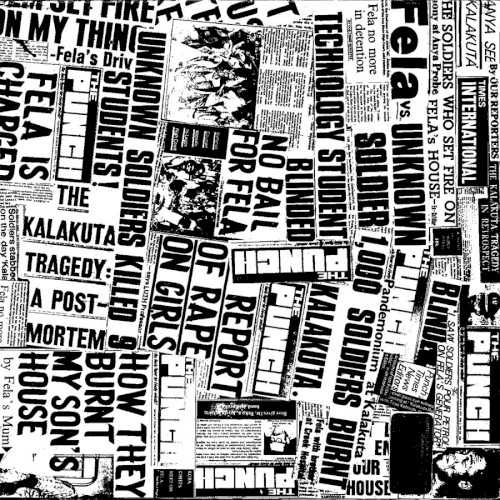 | Album: 31 of 49 Title: Unknown Soldier Released: 1979 Tracks: 2 Duration: 00:00 Scroll: Up Down Top Bottom 25% 50% 75% Spotify Allmusic AlbumCover | 1 Unknown Soldier (Instrumental) (?) 2 Unknown Soldier (Vocal) (?) |
 | Album: 32 of 49 Title: International Thief Thief (I.T.T.) Released: 1979 Tracks: 2 Duration: 24:13 Scroll: Up Down Top Bottom 25% 50% 75% AlbumCover | 1 I.T.T. (Instrumental) (11:19) 2 I.T.T. (Vocal) (12:54) |
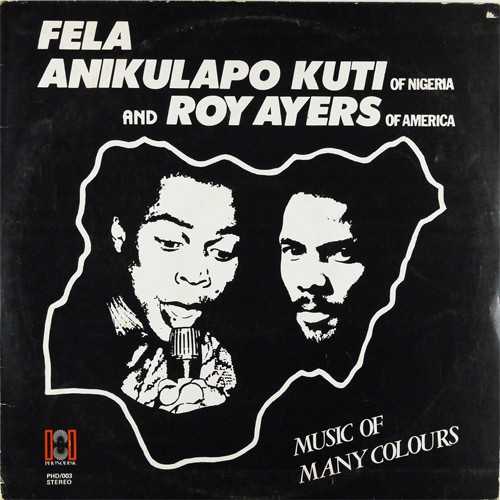 | Album: 33 of 49 Title: Music of Many Colours Released: 1980 Tracks: 2 Duration: 36:10 Scroll: Up Down Top Bottom 25% 50% 75% Allmusic AlbumCover | 1 2000 Blacks Got to Be Free (18:39) 2 Africa - Centre of the World (17:31) |
| Music of Many Colours : Allmusic album Review : This meeting of the minds and bands of Afro-funk creator Fela Anikulapo-Kuti and American vibist and R&B;/jazz innovator Roy Ayers is a collaboration that shouldnt work on the surface. Felas music was raw, in your face politically and socially, and musically driven by the same spirit as James Browns JBs. At the time of this recording in 1979, Ayers had moved out of jazz entirely and become an R&B; superstar firmly entrenched in the disco world. Ayers social concerns -- on record -- were primarily cosmological in nature. So how did these guys pull off one of the most badass jam gigs of all time, with one track led by each man and each taking a full side of a vinyl album? On hand were Felas 14-piece orchestra and an outrageous chorus made up of seven of his wives and five male voices. For his part, Ayers played vibes, and saxophonist Harold Land blew like the soul master he is. The rest of the Ayers septet performed on his tune only, the funk fest "2,000 Blacks Got to Be Free," an open-ended soul groove overdriven into Afro-funk by Felas orchestra. Ayers is down on the quick changes, and his band leads the orchestra in pulling down the funk into a hypnotic sway and groove. On Felas "Africa -- Centre of the World," everything starts out dark and slow with a chant from the master and then the chorus and Felas trademark tenor honk. The horn section kicks in and Ayers starts playing all around the mix like a restless spirit. He darts in and out of the changes and sometimes hovers above them. The effect is as mesmerizing as it is driving. This is a sure bet for any bash where you want em to dance until they drop. For the purpose of musical history, this was a meeting that panned out in all the right ways and left listeners with a stellar gift of a recorded souvenir. | ||
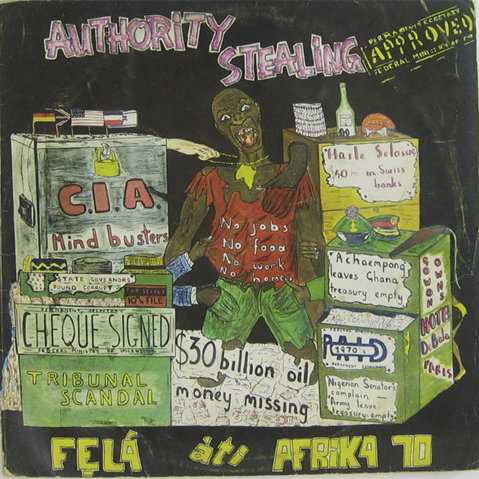 | Album: 34 of 49 Title: Authority Stealing Released: 1980 Tracks: 2 Duration: 24:20 Scroll: Up Down Top Bottom 25% 50% 75% TrackSamples Allmusic AlbumCover | 1 Authority Stealing, Part 1 (10:36) 2 Authority Stealing, Part 2 (13:44) |
| Authority Stealing : Allmusic album Review : Authority Stealing garnered Fela Anikulopo Kuti one of his most severe beatings by the hands of the Nigerian government. Fela is blunt in his attack on the figures of government that were responsible for stealing large sums of money in the form of market control. Ironically, the government arrested him (and other outspoken citizens) for an armed robbery, meanwhile beating Fela close to death. Strangely, the rhythm section on this song rolls on in a very mid-tempo, non-reactionary pattern. The solos are low-key and lackluster. All the while, Fela accuses the authority figures of being worse than armed robbers and deserving of hanging. Authority Stealing was originally distributed by Felas own Kalakuta Records as no other company would touch it due to its inflammatory remarks. Authority Stealing is a critical record as historical and cultural comment but not for its musical innovation. [MCA released Authority Stealing and V.I.P. as a two-fer in 2000.] | ||
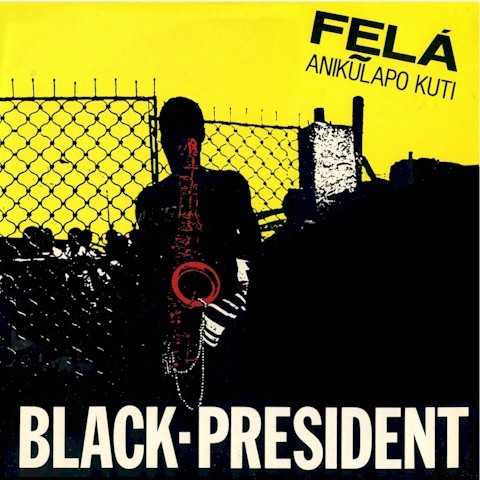 | Album: 35 of 49 Title: Black President Released: 1981 Tracks: 3 Duration: 42:00 Scroll: Up Down Top Bottom 25% 50% 75% Spotify Allmusic AlbumCover | 1 Sorrow, Tears and Blood (10:10) 2 Colonial Mentality (13:30) 3 I.T.T. (International Thief Thief) (18:20) |
| Black President : Allmusic album Review : It was during the early 80s that Fela Anikulapo Kutis profile was high enough to warrant releasing his records in the U.S. So for the first time, one did not have to scour the import bins or pay import prices to get a dose of Afro-beat. On Black President, the politics are at the forefront as Fela rails against colonialism and the military government growing rich at the expense of Nigerias poor. The grooves are dense and supple and in many ways this is classic Fela, it just doesnt kick quite as hard as Expensive Shit or He Miss Road. | ||
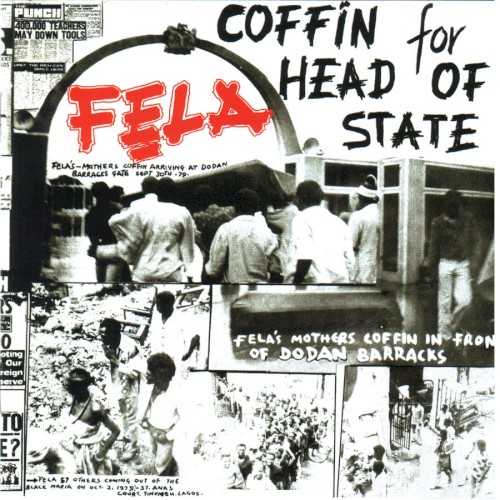 | Album: 36 of 49 Title: Coffin for Head of State Released: 1981 Tracks: 1 Duration: 22:42 Scroll: Up Down Top Bottom 25% 50% 75% Spotify AlbumCover | 1 Coffin for Head of State (22:42) |
 | Album: 37 of 49 Title: Unnecessary Begging Released: 1982 Tracks: 2 Duration: 30:16 Scroll: Up Down Top Bottom 25% 50% 75% Spotify TrackSamples Allmusic AlbumCover | 1 Unnecessary Begging (16:11) 2 No Buredi (Bread) (14:05) |
| Unnecessary Begging : Allmusic album Review : Pioneering musician, activist, and bandleader Fela Kuti is the first word in Afro-beat, making such strides in the genre over the course of his career that his contributions are foundational and nothing less than legendary. Unnecessary Begging (also known as No Bread) comes at a formative time in Felas massive discography, between two of his most championed releases, 1975s Expensive Shit and 1977s Zombie. While Unnecessary Begging was one of no less than five albums Kuti released in 1976, its use of wiry synthesizers intermingled with bright horns and energetic Afro-beat rhythms makes for a bedding of increasingly interesting sounds on top of which Fela lays down his sung-spoken political poetry lyrics. | ||
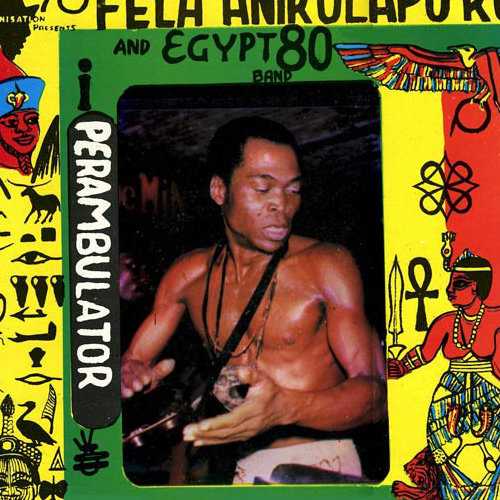 | Album: 38 of 49 Title: Perambulator Released: 1983 Tracks: 2 Duration: 00:00 Scroll: Up Down Top Bottom 25% 50% 75% Allmusic AlbumCover | 1 Perambulator (?) 2 Frustration (?) |
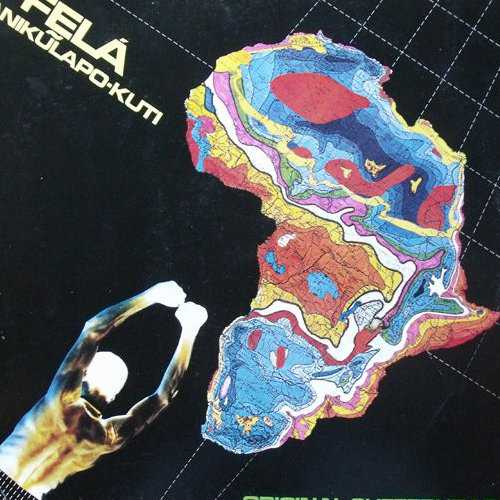 | Album: 39 of 49 Title: Original Sufferhead Released: 1984 Tracks: 2 Duration: 36:07 Scroll: Up Down Top Bottom 25% 50% 75% Spotify AlbumCover | 1 Power Show (14:55) 2 Original Sufferhead (21:12) |
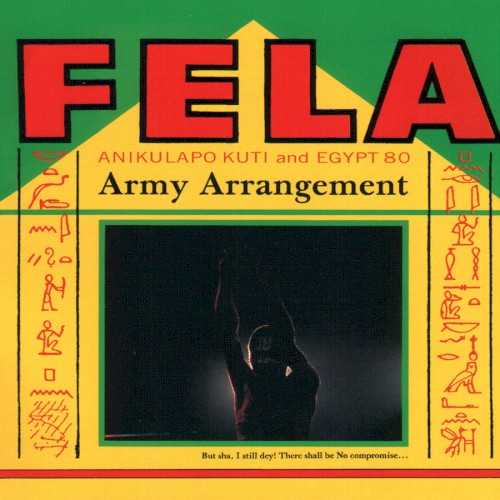 | Album: 40 of 49 Title: Army Arrangement Released: 1984 Tracks: 3 Duration: 34:17 Scroll: Up Down Top Bottom 25% 50% 75% Spotify TrackSamples Allmusic AlbumCover | 1 Army Arrangement (16:33) 2 Cross Examination (11:56) 3 Government Chicken Boy (05:48) |
| Army Arrangement : Allmusic album Review : Army Arrangement, originally released in 1985, was comprised entirely of a half-hour track of the same name. Just because its twice as long as Felas usual songs doesnt mean its twice as good. Its an average Fela recording, though the chanting chorus vocals come in earlier than they do on most of his pieces. The lyrics are among his most critical of the Nigerian military and government, focusing on the troubled period when the country returned to civilian rule at the end of the 1970s. Note that the MCA reissue of Army Arrangement is different from other releases with the same title, consisting of two tracks: a half-hour version of "Army Arrangement" and the previously unreleased, half-hour original version of "Government Chicken Boy." Musically, "Government Chicken Boy" is a little more interesting than "Army Arrangement," with ominous teams of horns and wordless chants leading into the usual trades of solos, and then a characteristic Fela lyric about obedient followers of authority. | ||
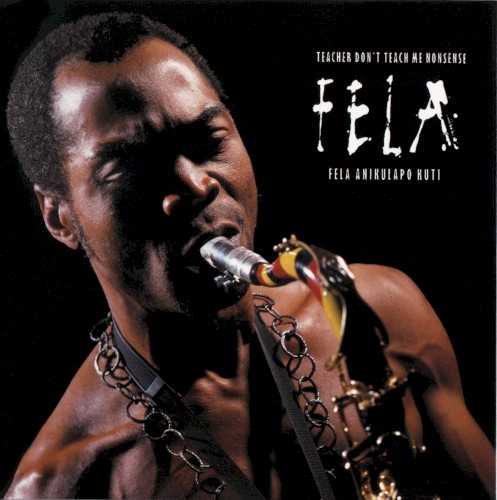 | Album: 41 of 49 Title: Teacher Dont Teach Me Nonsense Released: 1986 Tracks: 3 Duration: 1:18:51 Scroll: Up Down Top Bottom 25% 50% 75% Spotify Allmusic AlbumCover | 1 Teacher Dont Teach Me Nonsense (25:45) 2 Look and Laugh (30:49) 3 Just Like That (22:17) |
| Teacher Don't Teach Me Nonsense : Allmusic album Review : With production help from Wally Badarou, Fela Anikulapo Kuti offers up an interesting mix of songs (well, two to be exact) in both vocal and instrumental versions. Most compelling is the track "Look and Laugh," which details the attack by Nigerian soldiers on his Kalakuta compound. With simple lyrics, Fela runs down the horror of that attack in a detached, almost journalistic manner: "Till dem come/burn my house/burn my house/all my property/burn burn dem/beat beat me/kill my mama." Badarous production help gives Fela his most full-bodied sound; the horn section is much hotter and brassier than ever before. The problem with this record is that with following an instrumental track with a vocal version of the same song, theres a certain lack of drama that blunts the impact of songs as powerful as "Look and Laugh." That said, this is very good mid-80s Fela. The 2001 reissue on MCA adds a 22-minute bonus track, "Just Like That," which was originally released on 1989s Beast of No Nation album. | ||
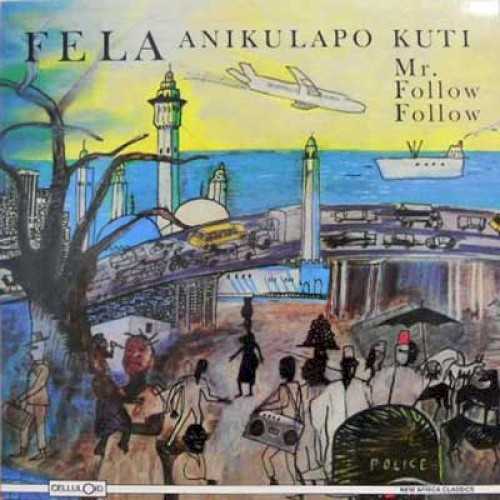 | Album: 42 of 49 Title: Mr. Follow Follow Released: 1986 Tracks: 2 Duration: 28:05 Scroll: Up Down Top Bottom 25% 50% 75% AlbumCover | 1 Mr. Follow Follow (12:59) 2 Who No Know Go Know (15:05) |
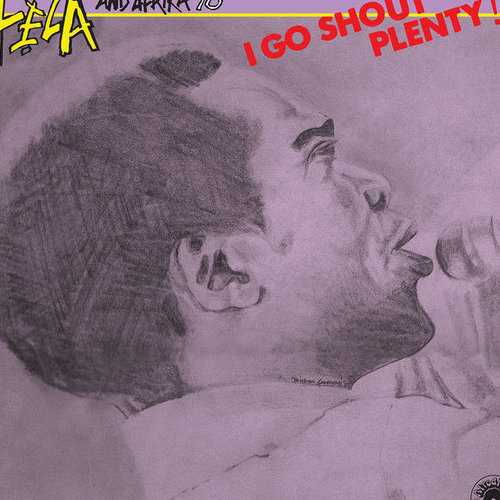 | Album: 43 of 49 Title: I Go Shout Plenty!!! Released: 1986 Tracks: 2 Duration: 28:23 Scroll: Up Down Top Bottom 25% 50% 75% AlbumCover | 1 I Go Shout Plenty (12:59) 2 Why Black Man Dey Suffer (15:24) |
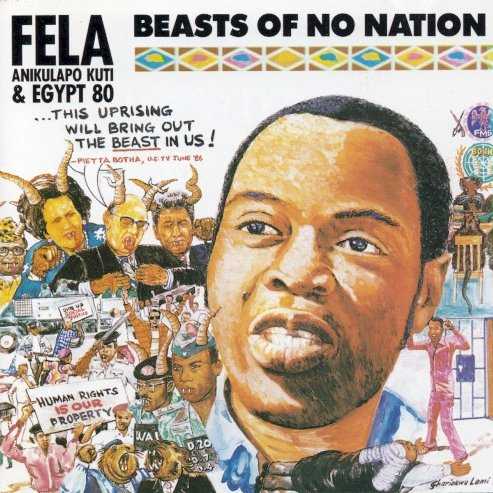 | Album: 44 of 49 Title: Beasts of No Nation Released: 1989 Tracks: 2 Duration: 35:36 Scroll: Up Down Top Bottom 25% 50% 75% Allmusic AlbumCover | 1 Beasts of No Nation (12:42) 2 Just Like That (22:54) |
| Beasts of No Nation : Allmusic album Review : After helping Fela Anikulapo Kuti with Teacher Dont Teach Me Nonsense, Wally Badarou was back in the producers chair for this effort, which was political in the extreme. That is to say, Kuti was in an extremely confrontational mood. The cover pictures former South African president P.W. Botha, Margaret Thatcher, and Ronald Reagan as horned vampires with blood dripping from their mouths. The music is more of the same, the grooves are typically sinuous, but the lyrics are venom-filled with Kuti referring to the aforementioned trio as "Animals wan dash our human rights." After a few so-so records in the early 80s, Beasts of No Nation was a strong (at times stunning) return to form for Kuti and signaled that his political beliefs kept him from becoming musically lazy. | ||
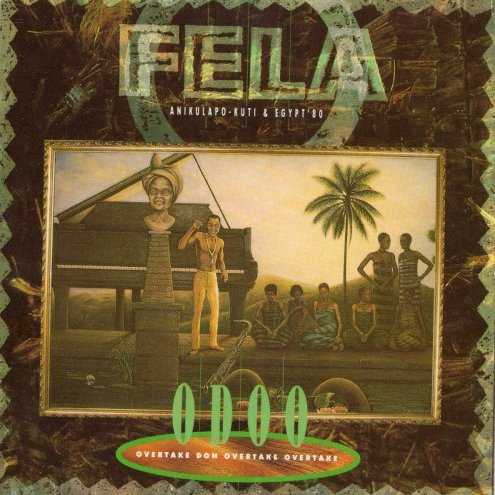 | Album: 45 of 49 Title: ODOO (Overtake Don Overtake Overtake) Released: 1989 Tracks: 2 Duration: 00:00 Scroll: Up Down Top Bottom 25% 50% 75% Allmusic AlbumCover | 1 Overtake Don Overtake Overtake (Instrumental) (?) 2 Overtake Don Overtake Overtake (Vocal) (?) |
| ODOO (Overtake Don Overtake Overtake) : Allmusic album Review : Even if American commercial radio did play more world music, theyd have a hard time with Fela Kutis albums -- which tend to be very loose and improvisatory and favor extended, jazz-influenced horn solos. Kuti believes in finding an irresistible groove or an appealing theme, staying on it, and working it to death -- something he has in common with everyone from Hindu and Islamic singers to James Brown and George Clinton. Its an approach that works wonders on this sets two extended pieces: the 31-minute "O.D.O.O. (Overtake Don Overtake Overtake)" and the 29-minute "C.B.B. (Confusion Break Bones)," both of which show us how appealing repetition can be with the right theme. Funk and soul fans will appreciate Kutis love of the endless groove, while jazz aficionados should pay attention to the long sax solos. Kuti has recorded many good albums over the years, and O.D.O.O. is certainly among them. | ||
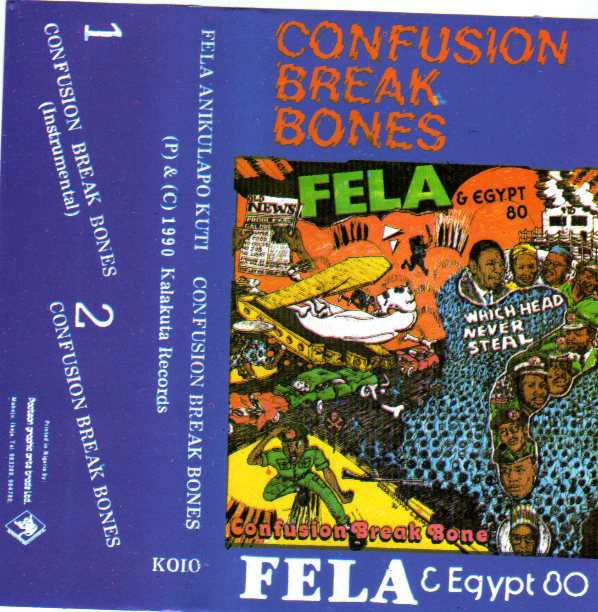 | Album: 46 of 49 Title: Confusion Break Bones Released: 1990 Tracks: 2 Duration: 00:00 Scroll: Up Down Top Bottom 25% 50% 75% AlbumCover | 1 Confusion Break Bones (Instrumental) (?) 2 Confusion Break Bones (Vocal) (?) |
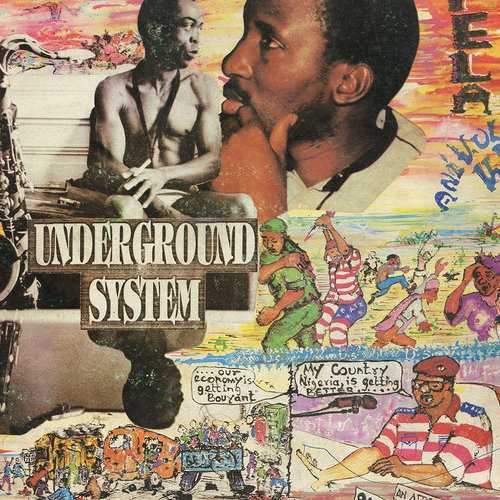 | Album: 47 of 49 Title: Underground System Released: 1992 Tracks: 2 Duration: 45:37 Scroll: Up Down Top Bottom 25% 50% 75% Spotify Allmusic AlbumCover | 1 Underground System (28:17) 2 Pansa Pansa (17:20) |
| Underground System : Allmusic album Review : Underground System was among the better recordings of Felas late career, comprised of two extended tracks, the title cut and "Pansa Pansa." "Underground System" starts off with rhythms that are far faster and more urgent than those on most of Felas characteristically lengthy tracks. If that sounds like a marginal quality upon which to judge a song as a standout, well, something like a much faster and played-as-though-we-mean-it tempo really does help to differentiate it from the singers generally similar output of the 1980s and 1990s. The backup singers also come in quickly with infectious chants, prior to a typical Fela lyric observing the difficulty in enacting positive political change in Africa. Hearing them sing in tandem with Fela instead of doing call-response patterns, as they do during much of the 28-minute cut, also makes for a refreshing variation. "Pansa Pansa," at a mere (for Fela) 17 minutes, also gets your attention more than his average effort, with rapid propulsive beats and sprinkles of slightly dissonant jazzy piano. The 2001 CD reissue on MCA adds a half-hour song from his 1990 album, ODOO, which is considerably slower and moodier than the prior two tunes, the beginning emphasizing mournful electric keyboards and sax soloing. | ||
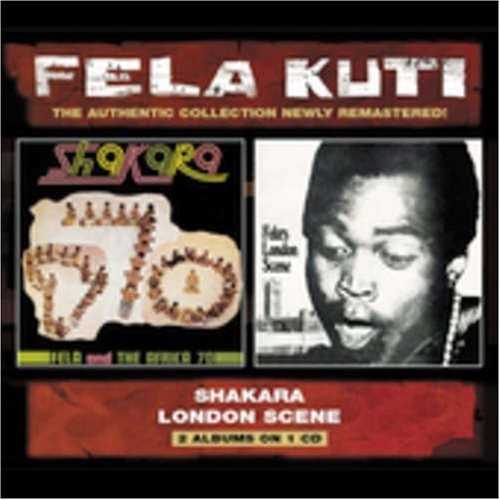 | Album: 48 of 49 Title: Shakara / Felas London Scene Released: 1997 Tracks: 7 Duration: 1:10:41 Scroll: Up Down Top Bottom 25% 50% 75% AlbumCover | 1 Lady (13:49) 2 Shakara (13:26) 3 JEhin JEhin (07:26) 4 Egbe Mi O (13:15) 5 Whore You (09:30) 6 Buy Africa (05:50) 7 Fight to Finish (07:24) |
 | Album: 49 of 49 Title: Ikoyi Blindness / No Buredi Released: 1998-08-25 Tracks: 4 Duration: 59:39 Scroll: Up Down Top Bottom 25% 50% 75% Allmusic AlbumCover | 1 Ikoyi Blindness (15:08) 2 Gba Mi Leti Ki Ndolowo (14:15) 3 No Buredi (No Bread) (14:05) 4 Unnecessary Begging (16:09) |
| Ikoyi Blindness / No Buredi : Allmusic album Review : In 1998, Victor released Ikoyi Blindness/No Buredi, which contained two albums -- Ikoyi Blindness and No Buredi -- by Fela Kuti on one compact disc. | ||